This appraisal is provided for informational and educational purposes only and does not constitute a certified, licensed, or formal appraisal.
Appraisal values are estimates based on submitted information, publicly available data, and input from InstAppraisal community, and may vary due to condition, provenance, regional demand, or additional information.
Appraisals must not be relied upon for insurance, legal, tax, or estate purposes without independent professional verification. InstAppraisal makes no guarantees regarding accuracy, completeness, or suitability for any specific use.
I forgot to add that at the…
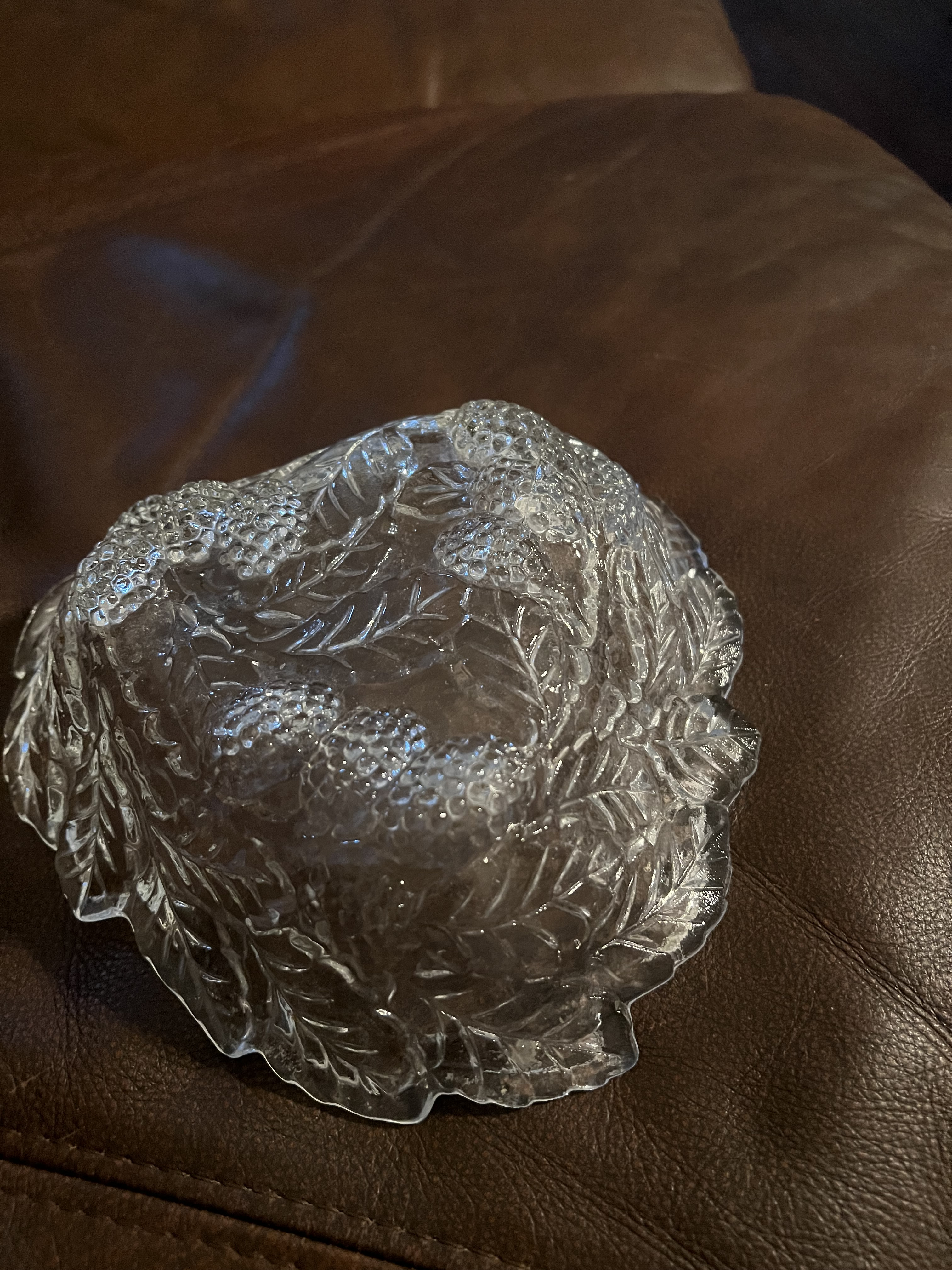
I forgot to add that at the highest the bowl is 2.25" (from the table to the top of the bowl).
Any information is appreciated. Thank you.
Purple-Based Ruffled Carnival Glass Bowl
Report: Purple-Based Ruffled Carnival Glass Bowl
Object Type: Small Decorative Bowl
Material: Pressed glass with iridescent (Carnival) finish
Base Color: Deep Amethyst/Purple
Iridescence: Vibrant multicolor, with dominant hues of yellow, teal, violet, and blue
Form: Ruffled/crimped edge bowl
Pattern/Motif: Abstract, radial swirls with central medallion (possibly “Peacock Tail,” “Cosmos,” or “Three-in-One” inspired); prominent radiating starburst on base
Dimensions:
Date of Manufacture: Circa 1910–1930
Condition: Excellent (no visible chips, cracks, or loss of iridescence)
Provenance: Collected by user's grandmother (b. 1910)
Maker’s Mark: None visible
Description & Authentication
This bowl is a fine example of early American Carnival Glass, characterized by its pressed glass base and iridized surface. The deep amethyst base color is among the most collectible, as it was more difficult and expensive to produce than the more common marigold. When held to light, the purple glass shows through the vibrant iridescent coating — a hallmark of true early production.
The radial swirl design on the interior appears to be a variant of a “swirl” or “flower petal” motif, often used by several manufacturers during the golden era of Carnival glass production. The exterior starburst and scalloped raysare highly decorative and point toward production by:
Among these, Dugan and Northwood were particularly known for purple bases with high iridescence and complex ruffled shapes.
The base shows a cut-style starburst design with alternating points — common in patterns like “Many Stars” or “Vintage,” but without a known pressed pattern name visible, this could be a lesser-known variant or a mold variation used by smaller operations or during later runs.
Historical Context
Carnival glass was introduced in the early 1900s as a more affordable alternative to expensive Tiffany or Steuben iridescent glass. It was distributed through dime stores, premiums, or given away at fairs — hence the name “carnival glass.” Purple (amethyst) examples were prized and often used for more decorative or elaborate molds.
Current Market Value (as of mid-2025)
Your piece is especially desirable due to its deep amethyst base, strong iridescence, excellent condition, and ruffled form. While smaller than some centerpiece bowls, its size makes it ideal for collectors of miniatures or display sets.
Conclusion & Recommendations
This bowl is a well-preserved early 20th-century example of American carnival glass, most likely produced by a recognized manufacturer but without a visible maker’s mark. Its combination of rich base color, crisp pattern, and radiant luster place it in the mid-to-high tier of collectible carnival pieces.
Recommendation: If desired, you could consult a carnival glass specialist (such as via the Carnival Glass Society or local appraisal fairs) for a more precise pattern/maker ID. However, based on your documentation and images, its value and collectibility are solidly established.