
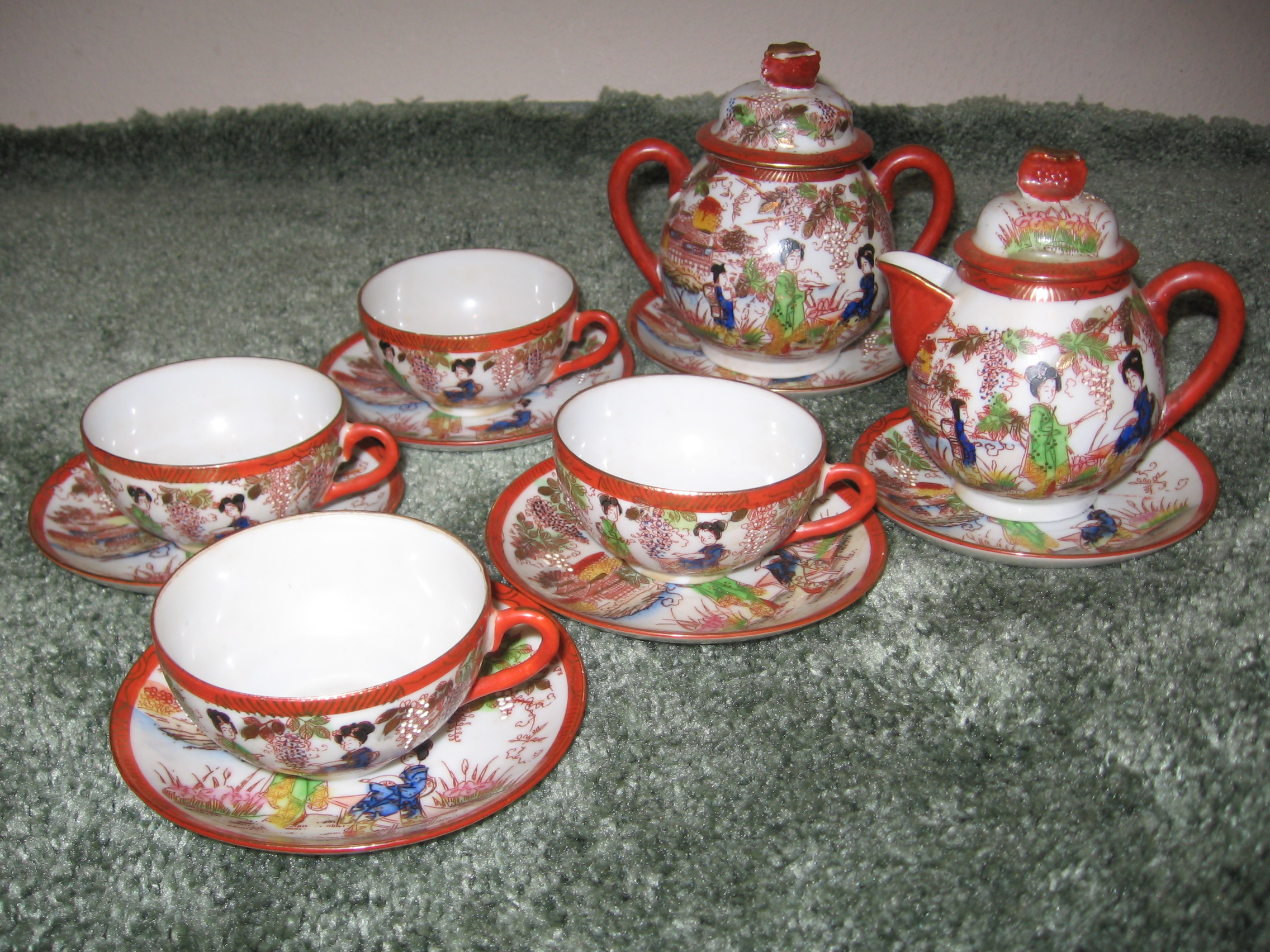
1900-30s Giesha Girls Tea Set
Community Appraisal
This item was appraised by the InstAppraisal community. Check the comments below for expert opinions and valuations.
Want an AI appraisal? Submit yours nowItem Details
I brought this tea set back from Germany and would like an appraisal/possibly sell. It was an heirloom from my wife's grandmother. It is fine bone (see thru) porcelain. From the markings on the pieces, it dates from the 1900-30s: Marking: http://gotheborg.com/marks/index_jap_marks.htm; This mark is Nippon Tokusei mark but with two unidentified characters ("mountain" = san something) probably 1900-30s.
I have found many copies of this Geisha Girls motif but none as densely image populated, intricately detailed nor with the gold highlights. For example, in addition to the extensive gold detailing on cup rims, the handles, the geisha girls' robes and the pagoda, each cup has eight, 1/8 in. x 1/16 in., 24ct. golden leaves as well. Of course, as they are hand painted, each piece is absolutely and discernibly unique in it's own right. This set appears to be one of a kind (the original iteration of this particular motif) if what is available on the internet is any indication.
The saucers are approximately 3.5" in diameter, the cups 2.5" dia. x 1.3" tall to provide size approximation for you. The only damage is a tiny chip on the lip of the sugar bowl (covered by the lid) and chips on either side of the sugar bowl lid gripping surface. Other than that there is no discernible wear or damage on any of the other pieces.
Good
Community Insights
Know something about this item? Collectors and experts share tips, identification help, and real-world experience here.
Have Something to Appraise?
Upload photos of your antique or collectible and get an AI-powered analysis in under a minute.
Get Your Appraisal →Comparable Items & Values
See how comparable items are valued
Comments
No comments yet. Be the first to share your thoughts!
InstAppraisal connects collectors but is not a marketplace. All transactions are between users at their own risk.