
Photos Submitted for Appraisal
🔍 Click to enlarge and inspect marks, signatures, and condition detailsTap to zoom and inspect details

AI Appraisal
Description
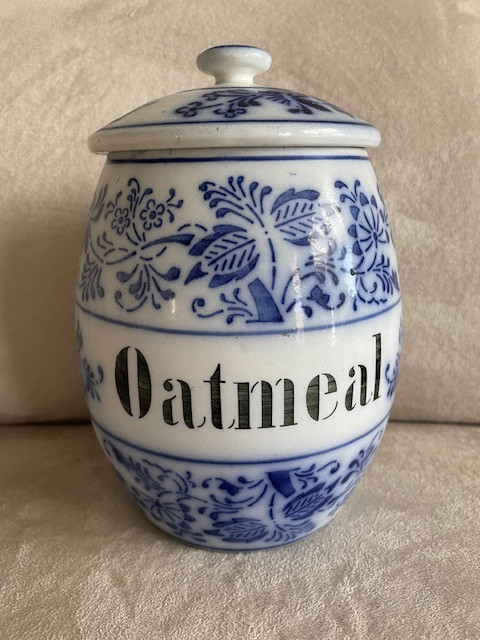
Blue and white "Blue Onion" pattern porcelain Oatmeal canister with lid.
Category
Ceramics and Porcelains
Medium
Porcelain
Distinguishing marks
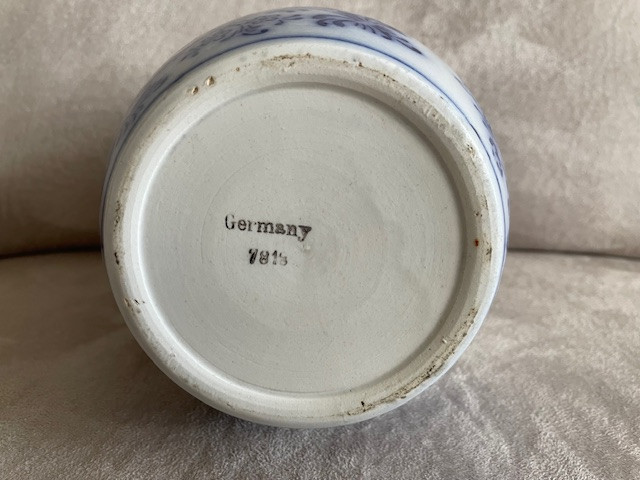
Stamped on bottom with country of origin, Germany, and number 781's (s may be an 8)
Condition
Excellent
Size and dimensions of this item
7-1/2 inches tall X 5 inches in diameter
Date Period
Unknown
Weight
1 lb. 8.7 oz.
History
Age unknown. I inherited it in 1980 from my mother who inherited it from her mother.
Price Paid (If known)
Unknown
Collectors with this item
Want to appraise yours? Upload photos for a free appraisal →
⚠️ You have 1 free appraisal left today
Upgrade for 15-30/day →
Want more from your appraisals?
View Plans →
Upgrade for PDF reports, more daily appraisals, and ad-free experience.
Collector Discussion
Do you recognize this piece? Collectors often identify maker marks, share comparable sales, or suggest additional research steps.
Blue Onion Porcelain Oatmeal Canister (Germany)
Identification & Description:
This is a blue and white porcelain oatmeal canister in the “Blue Onion” pattern, marked Germany on the base along with the impressed or stamped number 781’s (or possibly 7818). The design features stylized floral and leaf motifs typical of the Blue Onion (Zwiebelmuster) pattern, which originated in Meissen porcelain in the 18th century and has been widely reproduced in Germany and other European countries.
Origin & Date Period:
The Germany mark (without “West” or “East”) suggests manufacture prior to the division of Germany in 1949, or after reunification in 1990. Given the style, glaze, and font, it is more likely pre-WWII (circa 1900–1930), possibly from a porcelain maker in the Thuringia or Saxony region. The impressed or stamped number is likely a mold or pattern reference rather than a date code.
History & Use:
Such canisters were part of larger German kitchen storage sets, often including labeled jars for flour, sugar, rice, coffee, and spices. They were designed for practical use but are now collected for their decorative value and craftsmanship. Your family provenance — passed down from your grandmother to your mother and then to you — supports an early 20th-century acquisition.
Condition:
The piece appears to be in excellent condition, with no visible cracks, chips, or glaze loss. Retention of the original lid is significant for value.
Current Market Value:
Values for authentic antique German Blue Onion kitchen canisters vary depending on maker, condition, rarity of the label (“Oatmeal” is less common than “Rice” or “Flour”), and whether they are part of a complete set. Based on recent sales:
Authentication Notes:
While the style and mark are consistent with German porcelain from the early 20th century, identifying the exact maker (e.g., Meissen, C.A. Schramberg, or other Saxon/Thuringian factories) would require expert examination. A professional porcelain appraiser or auction house specializing in European ceramics could provide definitive authentication.
Recommendation:
Given the condition, provenance, and potential age, you may wish to have it professionally appraised if you ever decide to insure it or sell it, especially if you possess more canisters from the same set.
Some Additional Information That May Prove Helpful
German Porcelain Maker’s Mark Reference Chart (Blue Onion–Style Kitchenware)
Manufacturer: C.A. Schramberg (Schramberger Majolikafabrik)
Marking Style (1900–1930s): “Germany” stamped in serif letters; sometimes includes mold numbers underneath
Notes: Produced Blue Onion and floral kitchen canisters in the 1910–1930 period; often labeled in English for export
Likelihood for This Canister: Medium – English “Oatmeal” label fits export profile
Manufacturer: Villeroy & Boch (Mettlach)
Marking Style (1900–1930s): Often impressed or stamped “Germany” with a 3–5 digit mold number; no crest on utilitarian wares
Notes: Made many export kitchen sets with stenciled English labels
Likelihood for This Canister: High – mark’s simplicity and numbering are consistent
Manufacturer: Seltmann Weiden
Marking Style (1900–1930s): “Germany” in small serif font, sometimes with pattern number
Notes: Produced Blue Onion kitchenware in the 1920s–30s; labels often in German, but English labels for export exist
Likelihood for This Canister: Medium
Manufacturer: Bavaria region makers (e.g., Jaeger & Co., Winterling)
Marking Style (1900–1930s): “Germany” stamp, sometimes with “Bavaria” or floral mark; mold numbers below
Notes: Many exported blue-and-white canisters, sometimes English-labeled
Likelihood for This Canister: Medium-low (most included “Bavaria” if for export)
Manufacturer: Wallendorf
Marking Style (1900–1930s): Simple “Germany” mark; mold or style number impressed
Notes: Less common for kitchen canisters, but possible
Likelihood for This Canister: Low
Manufacturer: Reinhold Schlegelmilch (R.S. Prussia / R.S. Germany)
Marking Style (1900–1930s): Usually ornate “RS Germany” in wreath; rarely just “Germany”
Notes: Known for fine porcelain; rare for utilitarian canisters
Likelihood for This Canister: Low
Manufacturer: Meissen (post-1800s exports)
Marking Style (1900–1930s): Crossed swords mark; export pieces could be marked “Germany”
Notes: Would always include swords logo; not the case here
Likelihood for This Canister: Very low
How to Narrow It Down:
Recommendation:
AI Appraisal: Porcelain Blue Onion canister
💰 Estimated Value
Value estimate available
Confidence: 70%
Unlock the Full Appraisal
See detailed pricing logic, comparable sales, market context, and selling advice.
Create Free Account
Already have an account? Log in
Already submitted this? Check your email for access link.
📋 Maker Identification — Signature analysis and attribution...
📊 Market Context — Current demand and collector interest...
🏷️ Comparable Sales — Recent auction results and prices...
💡 Selling Strategy — Best venues and timing...