This appraisal is provided for informational and educational purposes only and does not constitute a certified, licensed, or formal appraisal.
Appraisal results are generated using automated systems, including artificial intelligence, and are based solely on the information and images submitted by the user, along with publicly available data. As such, results may contain inaccuracies, omissions, or errors.
InstAppraisal does not authenticate items. No determination of authenticity, origin, materials, maker, or age should be considered verified. Many items—particularly luxury goods, watches, jewelry, coins, art, and designer products—are frequently counterfeited and may closely resemble genuine examples. Authenticity cannot be confirmed from images alone.
Any statements regarding authenticity are expressions of opinion only and should not be relied upon as fact. Independent professional authentication is strongly recommended before any purchase, sale, or valuation decision.
Appraisal values are estimates only and may vary significantly based on condition, provenance, market demand, and additional information not available at the time of review.
Appraisals must not be relied upon for insurance, legal, tax, estate, or financial purposes without independent professional verification.
InstAppraisal disclaims all liability for any losses, damages, or disputes arising from reliance on this appraisal, including transactions conducted based on the information provided.
By using this service, you acknowledge and agree that you assume all risk associated with reliance on appraisal results.
Rocking Chair
Description:
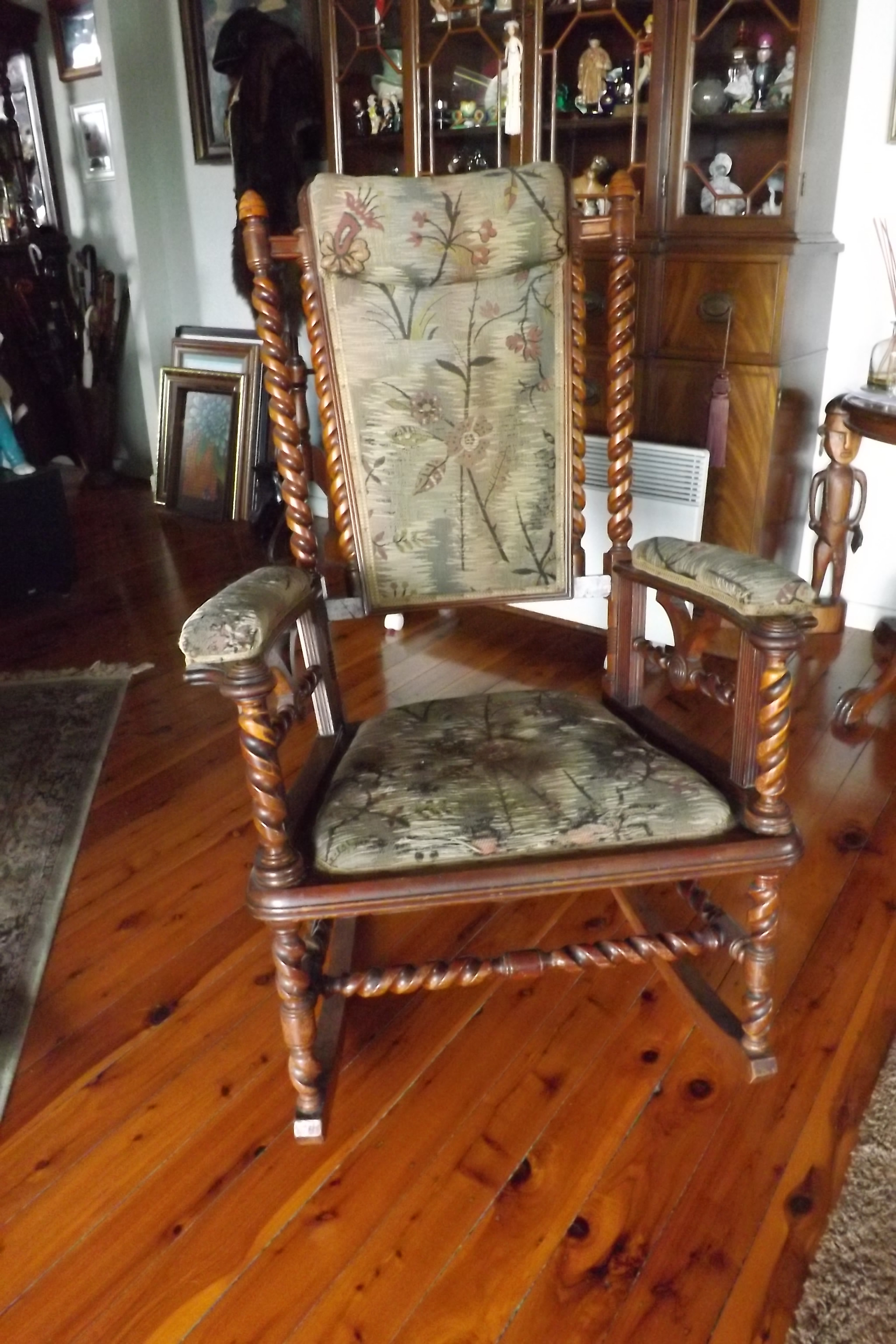
This is an ornate and beautifully crafted rocking chair with design elements that are reminiscent of late 19th to early 20th-century American furniture. The chair features barley twist spindles on the back posts, arms, and base stretcher, as well as a carved wooden frame. The upholstery is a floral-patterned tapestry, consistent with furniture of the Victorian era. The rockers are solid wood with a smooth curvature, characteristic of traditional handcraftsmanship.
Although the chair shares stylistic similarities with the work of George Hunzinger, a prominent 19th-century furniture maker, it is not a platform rocker, and no maker’s marks or other distinguishing features indicate that it is an authentic Hunzinger piece. The chair was purchased in Ohio, a region with a strong tradition of furniture craftsmanship during this period.
Design and Influences
The chair’s barley twist detailing and ornate woodwork align with Victorian and Eastlake design aesthetics, popular between 1880 and 1910. These styles emphasized intricate craftsmanship and decorative elements, making such pieces highly valued in American households of the time.
While the chair has a resemblance to Hunzinger’s work, several factors suggest it is not an original:
Condition
The chair is in good condition:
This chair remains a fine example of Victorian craftsmanship, maintaining its decorative and functional appeal.
History and Origin
The chair likely dates to the late 19th or early 20th century and was likely crafted in the Midwest, given its purchase in Ohio. Its craftsmanship suggests it was made by a skilled artisan or smaller furniture maker, rather than a notable designer like George Hunzinger. It reflects the broader Victorian-era trend of making elegant and functional rocking chairs for the home.
Comparable Sales and Value
Chairs of similar style and age typically fall within these ranges:
As this chair lacks visible marks or other defining characteristics linking it to George Hunzinger, it is best categorized as a Victorian/Eastlake-style rocking chair. Its estimated market value is $350–$450, reflecting its craftsmanship, condition, and decorative appeal.
Conclusion and Recommendation
This rocking chair is a charming and well-preserved example of Victorian craftsmanship, with elegant barley twist spindles and a floral tapestry upholstery that highlight its decorative appeal. While it shares some stylistic similarities with George Hunzinger’s designs, it lacks the distinctive features, patented mechanisms, and maker’s marks typically found in his work.
If you still believe this chair to be an original Hunzinger piece, we strongly recommend consulting a professional furniture appraiser or antique specialist in person for further evaluation. They may be able to uncover details or features not immediately visible in photographs. However, based on the absence of markings and the design features observed, it is most likely not a Hunzinger chair but rather a high-quality piece inspired by the broader Victorian-era trends. Regardless, of it being an original Hunzinger, it’s a beautiful example of a finely crafted rocking chair.
This is definitely not a…
This is definitely not a Hugzinger example, pieces like this one were mass produced examples, most made in the Grand Rapids Michigan area, then the furniture making capital of the world. A great many were sold via catalogs such as Montgomery-Ward and Sears- Roebuck at the turn of the 19th century, just before the Mission style began to dominate the market prior to World War One (1914). They are a tough sell right now, even in very good condition we'd have trouble getting much over $150.00, they often go for half that at auction.