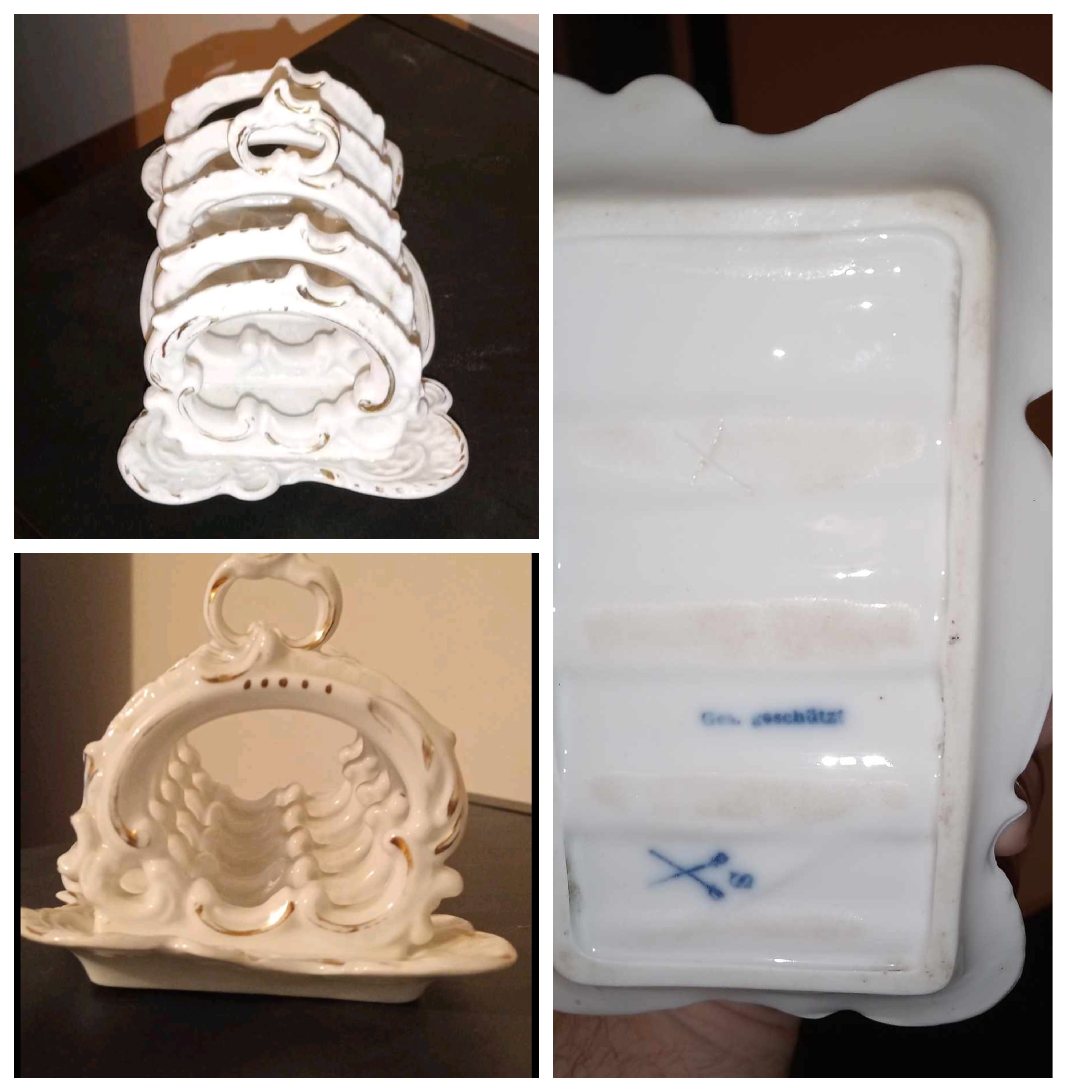
Vintage porcelain toast rack
G
7 months ago
AI Appraisal
Description

Vintage Porcelain Toast Rack or Napkin Holder White porcelain with gold accents. Given the markings on the bottom of the plate it is possibly from a company in Germany. Likely from the late 19th or early 20th century. 

Category Ceramics and Porcelains
Medium White porcelain with gold accents
Distinguishing marks 2 blue crossed swords with a small blue S above them is marked on the bottom of the plate.
Condition Excellent
Date Period 19th to 20th century
Want more from your appraisals?

Upgrade for PDF reports, more daily appraisals, and ad-free experience.

View Plans →

Submitted by NaidaTheCollector

Item Overview

  • Object: Porcelain Toast Rack (possibly also used as a napkin holder)
  • Material: White porcelain with hand-painted gold accents
  • Origin: Germany (based on marks)
  • Date: Likely late 19th to early 20th century (c. 1880–1920)
  • Condition: Excellent, with minimal visible wear and intact gilding
  • Distinguishing Marks:
    • Blue crossed swords with an "S" above – resembles the Meissen-style mark
    • "Ges. gesch." – abbreviation for "gesetzlich geschützt", meaning “legally protected,” a term used in Germany post-1890 to indicate a protected design or trademark

Maker & Attribution

The crossed swords motif is famously associated with the Meissen Porcelain Manufactory, the oldest European hard-paste porcelain producer (founded in 1710 in Saxony, Germany). However, due to its fame, the crossed swords were widely imitated by other porcelain manufacturers across Germany and Austria in the late 19th century.

The presence of the “S” above the swords suggests this is not an authentic Meissen mark, but rather a Meissen-style mark used by a different manufacturer—possibly Schierholz, Carl Thieme of Potschappel, or another Dresden-area porcelain maker that produced ornate Rococo-revival pieces for the export and domestic market.

The use of "Ges. gesch." suggests production was likely between 1890–1918, which aligns with the visual style and glaze quality of the piece.

Stylistic Notes

  • The ornate, scrollwork design and pierced handle are in the Rococo Revival style, which enjoyed popularity in decorative arts between 1850–1910.
  • The gold detailing is applied in a refined, delicate manner consistent with hand-finished German porcelain.
  • These toast racks were often part of larger breakfast or tea services in affluent homes.

Market Value Estimate

Based on similar items from reputable European makers with Meissen-style marks:

  • Auction/Resale Market: $75–$150 USD
  • Retail/Antique Dealer Value: $125–$225 USD

The exact value depends on the confirmed maker and whether it’s part of a matching set. Without definitive attribution to Meissen or another premium house, the value remains more modest, but collectible due to its craftsmanship and age.

Collector Interest & Notes

Collectors of German porcelain, especially from the Dresden and Saxony region, may find this appealing due to:

  • The mark and style mimicking Meissen
  • Excellent preservation and decorative appeal
  • Utility as both a display and functional tableware piece

Recommendations

  • Professional Appraisal: Recommended if you're considering insuring, auctioning, or confirming attribution. A professional porcelain appraiser or a specialist in German ceramics (e.g., Sotheby’s, Bonhams, or a Meissen expert) could confirm the maker based on glaze, weight, and finer stylistic elements.
  • Preservation Tip: Avoid scrubbing the gilded areas, as gold detailing is easily worn. Store in a padded, temperature-controlled environment.
📸 Quick Scan
Garage-Sale Mode Fast appraisals on the go