


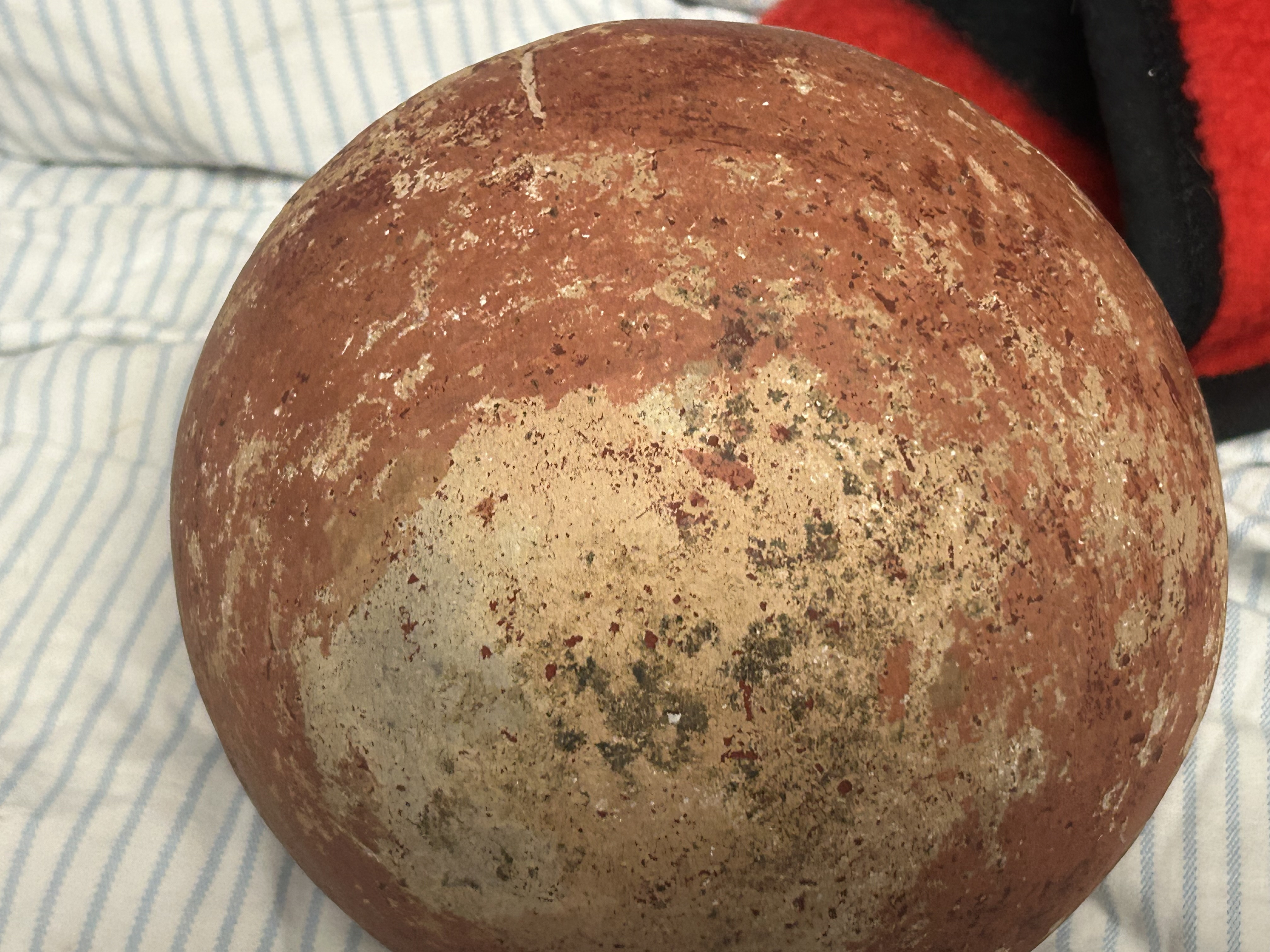

Click any image to enlarge

This is a Pot that was left to me by a family member who had a vast collection of artifacts and fossils. I have attached a photo of the name plate and the year associated with this artifact as well as photos of the top, the bottom and from the side. It's roughly 8 inches tall and at its widest point roughly 7 inches wide with the neck being roughly 2 inches tall with the opening being about 1.5 inches wide. I know this too has been in our family for a very long time, since the early 1900's. Once again, I have no clue what the value would be on something like this artifact. Should it be in a museum or should I have insurance added in case something was to happen to it? Just a few of the many questions that I have. Or is it worthless and a big, huge paper weight? Clearly I see the year listed on the name plate of the artifact but if I could learn more about it that would be great. Who used it, when was it used, where in the world, etc. Also the value would be nice and any other details you could provide would be fantastic as well. Thank You once again & God Bless
Neil
PH. 937-776-5120
email [email protected]
Upgrade for PDF reports, more daily appraisals, and ad-free experience.
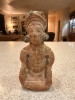

Stempot Pottery Vessel (Label: "Aztec–Oaxaca, 1200 A.D.")
Physical Description:
Cultural and Historical Context:
This vessel is described as originating from the Aztec or Oaxaca region, dated around 1200 A.D. This date places it in the Postclassic period of Mesoamerican civilization—a time of rising complexity and trade between regional powers.
Authentication Notes:
Preliminary Value Estimate:
If authentic, your piece could be valued between $1,500 and $4,000 USD in the retail collector market, or more depending on provenance and institutional interest.
If determined to be a well-made reproduction, its value would be closer to $100–$300 USD
Recommendations:
Consider sending the vessel to a professional appraiser or institution offering thermoluminescence dating (e.g., The Smithsonian, The Getty, or commercial services like Oxford Authentication Ltd).
If confirmed to be authentic, yes—insuring it would be advisable. Document its condition, ownership history, and photos.
Authentic Mesoamerican artifacts of this era are of interest to academic collections and museums, particularly if tied to family history and acquired before cultural patrimony laws of the mid-20th century. Provenance will be key.
Summary:
Your "Stempot" labeled as Aztec–Oaxaca, 1200 A.D., appears to be either a genuine artifact or a high-quality historical reproduction. It is culturally significant and worth authenticating. The condition is remarkable, and if genuine, it could command serious interest from collectors, museums, or academic institutions.