This appraisal is provided for informational and educational purposes only and does not constitute a certified, licensed, or formal appraisal.
Appraisal results are generated using automated systems, including artificial intelligence, and are based solely on the information and images submitted by the user, along with publicly available data. As such, results may contain inaccuracies, omissions, or errors.
InstAppraisal does not authenticate items. No determination of authenticity, origin, materials, maker, or age should be considered verified. Many items—particularly luxury goods, watches, jewelry, coins, art, and designer products—are frequently counterfeited and may closely resemble genuine examples. Authenticity cannot be confirmed from images alone.
Any statements regarding authenticity are expressions of opinion only and should not be relied upon as fact. Independent professional authentication is strongly recommended before any purchase, sale, or valuation decision.
Appraisal values are estimates only and may vary significantly based on condition, provenance, market demand, and additional information not available at the time of review.
Appraisals must not be relied upon for insurance, legal, tax, estate, or financial purposes without independent professional verification.
InstAppraisal disclaims all liability for any losses, damages, or disputes arising from reliance on this appraisal, including transactions conducted based on the information provided.
By using this service, you acknowledge and agree that you assume all risk associated with reliance on appraisal results.
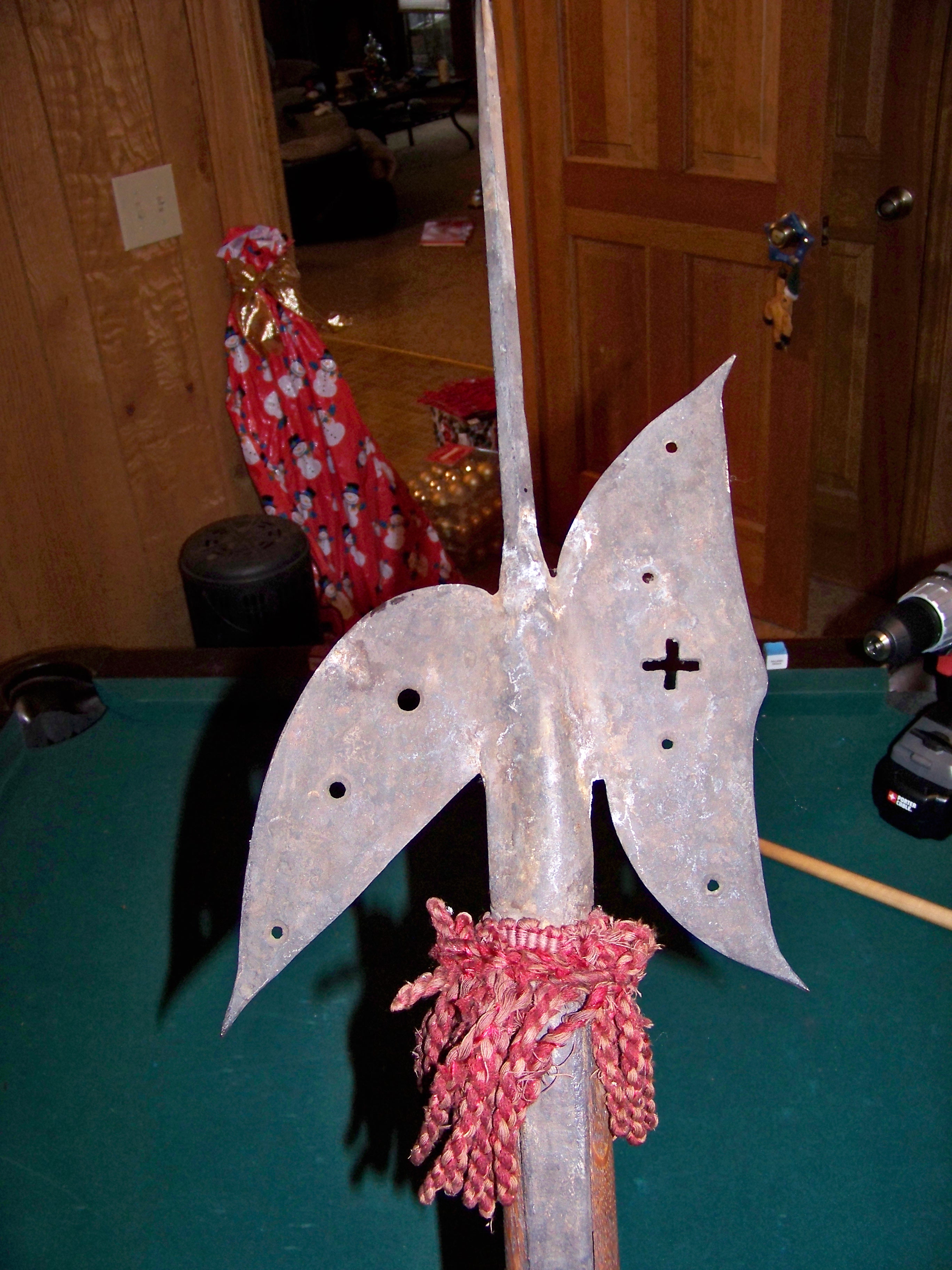
Re: Iron Halberd Swiss or German maybe, has celtic type cross...
Your pictures are very detailed, well done.
The halberd does not appear to be in very good condition as it appears there is quite a bit of rust on the head.
The problem in trying to identify the type and age is that these were generally used as weapons in the 16th and 17th centuries and they were reproduced in the 19th centruy as decoration. Sometimes it is almost impossible to tell the 16th century originals from the Victorian era reproductions.
The good thing is that generally they both have value. I have 4 halberds personally, purchased from auction, and all 4 are Victorian era. These reproductions generally sell for $600-900 each, whereas the 16th or 17th century ones go for $800-1300 each.
You can go online to www.faganarms.com. This is a website of a dealer that sells medieval weapons and armor. They generally have halberds for sale. There is also an auction by Thomas del Mar in London on May 7, in association with Sotheby's where they are selling a large collection of medieval arms and armor. There are a number of both original 16th and 17th century halberds and 19th century reproduction halberds for sale. You can look to see what the auction estimates are. They also provide additional information as to country of origin, so you can compare swiss, german, italian, etc. Just google search thomas del mar auction and you should be able to pull it up.
Overall I would say since the condition does not appear to be the best, your halberd is probably not worth more than $800.
Cyberhusky
Re: Iron Halberd Swiss or German maybe, has celtic type cross...
A pole weapon or polearm is a close combat weapon in which the main fighting part of the weapon is fitted to the end of a long shaft, typically of wood, thereby extending the user's effective range. Glaives, poleaxes,halberds, and naginatas are all varieties of pole-arms.
The purpose of using pole weapons is either to extend reach or to increase angular momentum—and thus striking power—when the weapon is swung. Because they contain relatively little metal, pole-arms are cheap to make. This has made them the favored weapon of peasant levies and peasants in rebellion the world over. Many are adapted from farm implements, or other tools.
Pole-arms were common weapons on medieval European battlefields. Their range and impact force made them effective weapons against armored warriors on horseback, because they could penetrate armor. The Renaissance saw a plethora of different varieties. Pole-arms in modern times are largely constrained to ceremonial military units such as the Papal Swiss Guard or Yeomen of the Guard or traditional martial arts.Chinese Martial Arts in particular have preserved a wide variety of weapons and techniques.A halberd (also called halbard, halbert or Swiss voulge)
https://www.pinterest.com/pin/573083121304196512/
you might find this chart interesting.
here is what I think you have.
Rare 16th-17th C. Swiss or German Halberd (Axe, Spear, Polearm, Sword) "NOTE" I do not claim to be an expert I have looked real close at your photos I think it real.